

"Show Me Your Elbow": The 4-Word Cue That Turns an Old-School Forehand Modern

"Show Me Your Elbow": The 4-Word Cue That Turns an Old-School Forehand Modern
You swing harder, the ball goes faster, and it lands somewhere near the back fence. A former touring pro had the same old-school forehand and rebuilt it into a modern one. Two short cues did most of the work, and neither one is "swing harder."
Breakdown based on Your Online Tennis Coach's Forehand Transformation, Episode 2, plus our self-check and drills for club players. ~9 min read.
SHOW ME THE CUEThe short version
Legs take you to the ball. The upper body helps the arm swing. Don't lock them together.
Start on the back foot, finish on the front. Shift too early and the power is gone.
Rotate all the way through so your elbow faces the net at the finish.
Let the racket go so the butt of the handle points at your target. Loose hand required.
Why so many club forehands are stuck in the past
The coach behind Your Online Tennis Coach played professional tournaments, retired in 2006 and has taught since. Their forehand was old-school too. In this episode of their Forehand Transformation series, they explain the changes that made it modern, and they're clear it can be done at any age, however you learned.
The turning point was understanding what the upper and lower body are each for. A lot of players lock both together to get power. You can hit the ball hard that way, the coach says, but there won't be any accuracy.
Your legs are a train taking you to the ball. Your upper body is you inside the train, reaching out to pick something up and bring it back.
Back foot to front foot, in that order
Start with your weight on the back foot and finish with it on the front foot, while the upper body and arm build the stroke in between. The common mistake: getting excited and shifting the weight too early. By the time you hit the ball, the power is spent and you're up on your toes.
The exercise that locked this in for the coach was throwing a medicine ball against a wall. It teaches the legs to be the balance, the upper body to help the arms, and the trust to keep rotating through the finish while the legs pick you up at the end.
The coach added this work during rehab after back surgery. If you have a back problem or any injury, check with a qualified professional before adding medicine-ball throws.

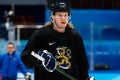
Back foot to front foot, body rotating through. Screenshot: Your Online Tennis Coach (YouTube).
The two cues that changed everything
The coach calls the first one of the most important instructions they'll ever give you. The second one is its partner.

A coach in Pennsylvania kept repeating it. It does several things at once. To show your elbow, you have to rotate your upper body completely, so your hand can fully brush up the back of the ball and finish. Many players don't, because they keep their hips tight to control the stroke. Control, yes. Power, no.
It also makes you aware of your joints. Think about the elbow and you start noticing the wrist too, and you have to relax it. A relaxed, fast hand is what puts real topspin on the ball.

To point the butt of the handle at your target at the finish, you have to let the racket go all the way. That only happens if your hand, elbow and shoulder are loose.
The coach's point about both cues: they're visual. You can see the stroke in your head and build it by imagining the finish, instead of memorising positions.
Old-school or modern? The 10-ball check
Our quick test. Hit 10 forehands and freeze at the finish each time. Ask a partner, or film it on your phone.
Our drills to modernise your forehand
RocketGrip drills built around the coach's cues. Start slow. Speed comes last.
20 slow shadow forehands. Freeze at the finish and check: elbow facing the net? End cap at the target? Only then speed up.
On feeds, say "back" as you load and "front" as you hit. If "front" comes before contact, you're shifting too early. 3 sets of 10.
Rally cross-court at 60% pace, clearing the net by a racket length. Focus only on a loose hand and showing your elbow. Count to 20.
Next lesson, ask your pro "why?" after every instruction. The coach's point: once you understand why something works, you don't have to memorise it.

Gear note: a loose hand needs a handle it trusts
Both cues only work with a loose hand and wrist. The usual reason club players squeeze is that the racket feels like it might move. That's mostly technique and habit, and no product will rotate your shoulders for you. But the handle under your fingers plays a part in how secure a light hold feels.
That's why we built the Octopus Tennis Undergrip. It goes under your usual overgrip and is designed to give a more secure, tacky feel and a customisable handle shape. Your Online Tennis Coach has nothing to do with it.
★ 4.7/5 from 50,000+ RocketGrip customers · 60-day money-back guarantee
Frequently asked questions
What does "show me your elbow" mean on a forehand?
At the end of the stroke, your elbow should face the net. Getting there forces full upper-body rotation, lets your hand brush up the ball completely, and requires a relaxed wrist.
What's the difference between an old-school and a modern forehand?
Broadly, a modern forehand separates the jobs of the legs and the upper body, rotates fully through the ball and uses a loose hand to create topspin. Older styles tend to push the ball with a stiffer arm and less rotation.
Why do I lose power when I shift my weight forward?
You're probably shifting too early. Start on the back foot and finish on the front foot through contact. Shift before the ball arrives and the power is spent by the time you hit.
Can I modernise my forehand at 40 or 50?
The coach says yes, regardless of age or how you learned. Take it in stages, start with slow shadow swings, and build speed only once the finish is right.
Will a different grip on my racket fix my forehand?
No. Rotation, timing and a loose hand do that. The Octopus undergrip is designed to give a more secure, tacky feel and a customisable handle shape, which can make a lighter hold feel more comfortable. If you have pain while playing, see a qualified professional.
Watch the full forehand transformation episode
Eight minutes. Jump to 4:10 for "show me your elbow" in action.
Video won't play? Watch on YouTube →
Show me your elbow. Show me the end cap.
That's the modern forehand in two pictures. Legs take you there, back foot to front foot, rotate all the way through, and keep the hand loose enough to let the racket go.
Give that loose hand a handle it trusts.
OCTOPUS UNDERGRIP →- ★ 4.7/5 from 50,000+ RocketGrip customers
- 60-day money-back guarantee

Source: "How I Transformed My Forehand: The Secret to Effortless Power (Ep. 2)" by Your Online Tennis Coach (YouTube), October 2026. RocketGrip is not affiliated with Your Online Tennis Coach. This article summarises and builds on their publicly available video; the 10-ball check, drills, mistakes and gear notes are ours. No endorsement implied. The screenshot is from the credited video and used for commentary; other images are illustrations. This article is general coaching information, not medical advice. If you have pain while playing, see a qualified professional.